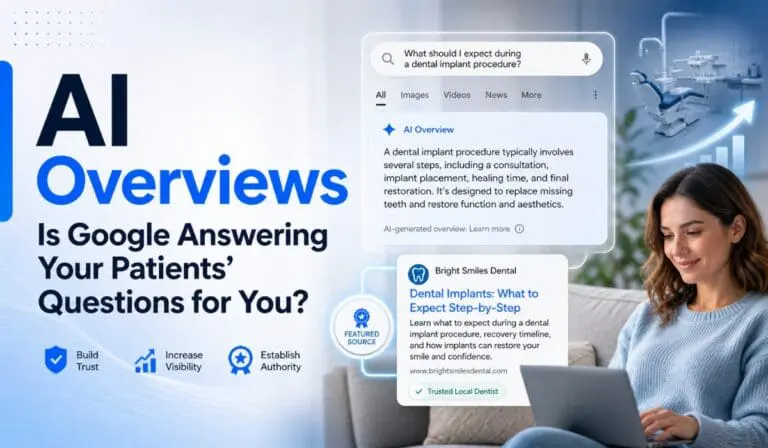
AI Overviews: Is Google Answering Your Patients’ Questions for You?
Imagine a prospective patient sitting on their couch, anxiously wondering: “What should I expect during a dental implant procedure?” In the past, they would click your blog link, read your carefully crafted explanation, and see your CTA. Today, Google often does the talking for you. With AI Overviews (formerly SGE), Google provides a comprehensive, conversational summary at the very top of the search results, pushing those traditional “blue links” further down the page.
If Google is answering the question, you might worry that the patient has no reason to click through to your site. However, the reality is the opposite: Google’s AI doesn’t just make up answers; it “crawls” high-quality dental websites to find them. If your content is the source, your practice is cited with a prominent link, positioning you as the immediate authority before the patient even scrolls.
Do I need to worry about this?
This shift is about NP starts and high-value production. If a patient searching for complex restorative work sees your practice cited as the expert source by Google’s AI, you’ve won the “trust” battle before the first phone call. Conversely, if your website only contains thin marketing fluff, you become invisible in this new AI-driven landscape. To stay relevant, your site must move from being a digital brochure to an “answer engine.”
How to “Feed” the AI and Capture Patients
To ensure Google chooses your practice as the cited authority, you need to structure your content for Generative Engine Optimization (GEO). This means moving away from dense paragraphs and toward clear, structured data.
Implement “Micro-Answers”: On your service pages, include a 2-3 sentence summary (roughly 50 words) directly under your H2 headings. For example, under “How long do veneers last?”, start with a direct, factual answer before expanding.
Build a Robust FAQ Ecosystem: Don’t just have one FAQ page. Add 3-5 specific, question-based headings to every high-value treatment page (Implants, Invisalign, Sleep Apnea). Use the exact phrasing patients use in the chair.
Leverage Schema Markup: Use technical “FAQ Schema” code behind the scenes. This acts as a translator, telling Google’s AI exactly which part of your page contains the answer it’s looking for.
Is your website ready for the AI era, or are you losing visibility to the practice down the street? Contact Bullseye Media today for a comprehensive digital strategy review, and let’s ensure your practice is the one Google recommends.