Short Form Video is Key to Winning in 2026
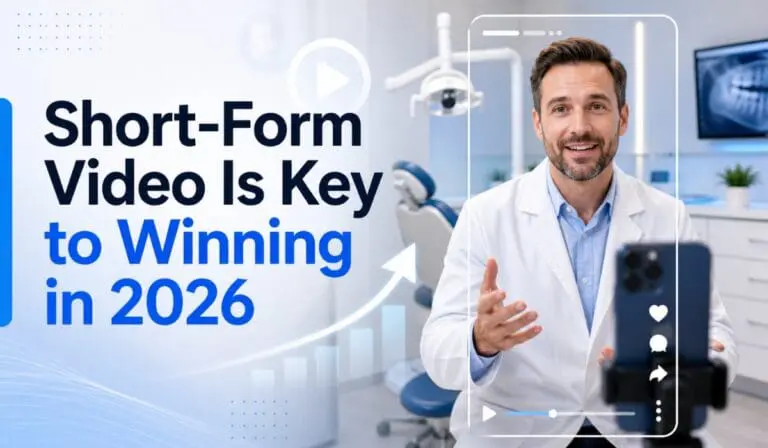

In the fast-moving digital landscape of 2026, the traditional “first visit” to a dental office has been fundamentally disrupted. It no longer happens when a patient walks through your front door and checks in with the receptionist. Instead, the first visit happens in the palm of their hand—on a smartphone screen, often at 9:00 PM while they are scrolling through social media or an AI-generated search summary.
As a marketing agency, we’ve seen a seismic shift: patients are no longer just looking for a “dentist near me.” They are looking for a feeling of safety. In an era where 58% of Google searches result in zero clicks to a website because AI summaries provide all the basic facts, your clinical credentials alone aren’t enough to get someone in the chair. To win in 2026, you must build Visual Trust.
Short-form video has evolved from a “nice-to-have” social media tactic into the single most powerful conversion tool in a dental practice’s marketing arsenal. Here is why short-form video is the new “first visit” and how your practice can leverage it to dominate your local market.
The Psychology of Visual Trust: Why Video Wins in 2026
Dental anxiety remains one of the greatest barriers to care. Despite the technological leaps we’ve made in painless dentistry, the “fear of the unknown” still keeps millions of patients from booking.
Visual Trust is the antidote to that fear. When a prospective patient sees your face, hears the tone of your voice, and watches the way your team interacts before they ever step foot in your office, the “unknown” becomes “known.”
From “Information” to “Connection”
Traditional marketing focuses on information: your hours, your services, and your location. But 2026 patients are information-saturated. They want connection. Short-form video (content under 60 seconds) allows a patient to perform a “vibe check” on your practice.
- The Voice: Is the dentist calm and reassuring?
- The Environment: Does the office look clean, modern, and welcoming?
- The Team: Do the hygienists seem like people I’d be comfortable with for 45 minutes?
By the time a patient actually calls your office, they should already feel like they know you. That is the power of the digital first visit.
The 5 Pillars of a High-Conversion Video Strategy
You don’t need to be a “content creator” or a TikTok dancer to make this work. In fact, in 2026, authenticity beats production value every single time. Data shows that raw, handheld videos of a doctor answering a question have 45% higher engagement than over-produced, scripted commercials.
Here are the five types of videos every practice should be producing:
1. The “Virtual Handshake” (Meet the Team)
This isn’t a stiff, professional bio. This is a 30-second clip of your lead hygienist explaining why they love working with nervous patients, or a “day in the life” snippet of your front desk team.
The Goal: Humanize the brand. Show the faces that will be greeting the patient.
2. Clinical Micro-Education
Forget the long-winded blog posts about the history of dental implants. In 2026, patients want the “TL;DR” (Too Long; Didn’t Read).
- “Why do I need a crown instead of a filling?”
- “What does a 3D scan actually show me?”
- “How long does professional whitening really last?”
The Strategy: Film 60-second answers to the top 10 questions you get asked in the operatory every day.
3. The Office “Walkthrough”
Anxiety stems from the unknown. Use your phone to film a first-person perspective (POV) of walking through the front door, checking in, and sitting in the chair. Show the “amenities”—the weighted blankets, the ceiling TVs, or the coffee bar.
The Goal: Remove the physical mystery of the office visit.
4. Myth-Busting & Reaction Videos
With the rise of “DIY Dentistry” hacks on social media, there is a lot of bad advice out there. Short-form video allows you to step in as the Authority of Truth.
- React to a viral (but dangerous) whitening hack.
- Explain why “charcoal toothpaste” might be doing more harm than good.
The Strategy: Use the “Stitch” or “Duet” features to provide expert commentary on trending topics.
5. Patient Transformation Stories
Static “Before and After” photos are great, but a 15-second video of a patient seeing their new smile for the first time is emotional gold.
The Goal: Sell the result, not the procedure.
The “Zero-Click” Advantage: Video and SEO in 2026
Why are we emphasizing video so heavily right now? Because Google has become a video engine.
In 2026, Google’s AI Search Generative Experience (SGE) prioritizes video content in its search summaries. When a patient searches “Best Invisalign dentist in [City],” Google doesn’t just look for keywords on your website; it looks for relevant video content on YouTube (which Google owns) and Instagram.
The Search Engine Leap
By embedding short-form videos on your service pages, you are signaling to AI search engines that your content is high-value and “human-verified.” A page with a 60-second video explaining a procedure is 53 times more likely to rank on the first page than a page with text alone.
Furthermore, these videos populate the “Video” tab and the “Social” snippets in search results, giving you multiple “points of entry” for a single search query.
Overcoming “Camera Cringe”: A Guide for Doctors
The biggest hurdle isn’t the technology—it’s the hesitation of the dentist to get in front of the lens. If you’re feeling “Camera Cringe,” keep these three rules in mind:
- Stop Trying to be “Professional”: In 2026, “professional” is often code for “boring and untrustworthy.” Patients trust people, not personas. If you stumble on a word or laugh, keep it in. It makes you relatable.
- Focus on One Person: When you look at that little black dot on your phone, don’t imagine an audience of thousands. Imagine you are talking to the patient currently sitting in Chair 2. Speak to them.
- The “One-Take” Rule: Don’t spend two hours editing. If the information is accurate and your face is visible, it’s good enough to post. Consistency is more important than perfection.
The Tech Stack: High Impact, Low Cost
You do not need a film crew. In fact, a film crew often kills the “authenticity” that 2026 patients crave. To get started, all you need is:
- A Modern Smartphone: (iPhone 15 or later / Samsung S25 or later).
- A Ring Light or Natural Window Light: Lighting is the difference between “amateur” and “authentic.”
- A Clip-on Wireless Mic: Audio quality is actually more important than video quality. If they can’t hear your reassurance, the video fails.
An AI Editing Tool: Use tools like Descript or CapCut to automatically add captions. (80% of people watch social media videos with the sound off!)
How to Measure Success (It’s Not About “Likes”)
As a marketing agency, we don’t care if your video goes viral in another state. We care if it drives High-Value New Patients in your zip code.
In 2026, we measure video ROI through:
- Vibe-to-Lead Ratio: How many people watched a video and then clicked the “Book Now” button in your bio?
- Case Acceptance: Are patients coming in already “sold” on a treatment because they watched your video explainer the night before?
Reduction in No-Shows: Patients who feel a personal connection to the doctor via video are significantly less likely to ghost their first appointment.
The Window is Closing
In 2026, the gap between “Digital-First” practices and “Traditional-Only” practices is widening into a canyon. Patients are choosing their healthcare providers based on the transparency and trust they find online.
If a patient is choosing between two dentists—one with a gallery of stock photos and a “Request Appointment” form, and another with a series of warm, helpful videos introducing the team and explaining the “why” behind their care—the choice is made before the first phone call is ever dialed.
Short-form video isn’t a trend; it’s the new standard of patient communication. Your first visit has already started. The only question is: what are your patients seeing?