Most dental practices would love more Google reviews. Very few have a system for getting them. The result is that review counts grow slowly and inconsistently, which means practices miss out on one of the highest-ROI activities available to them.
The challenge is that asking for reviews feels uncomfortable to a lot of practice teams. It can feel like asking for a favor, or like something a pushy salesperson would do. When you reframe it, though, the discomfort largely disappears.
Patients who have had a good experience at your practice and who see your team working hard often want to help. They just do not think to leave a review unless someone asks. You are not imposing. You are giving them an easy way to do something they would genuinely like to do.
Here is a system that works well for practices of all sizes.
Start by identifying the right moment.
The best time to ask for a review is immediately after a positive interaction, not weeks later in a follow-up email that has been forgotten. When a patient says, ‘thank you so much, that was easier than I expected’ or ‘I always dread coming, but you made it fine,’ that is the moment. A simple, natural response: ‘We really appreciate that. If you ever have a minute, a Google review means a lot to a small practice like ours.’
Back it up with a frictionless process.
The biggest barrier to reviews is not willingness. It is friction. People intend to leave a review and then never quite get around to it. A QR code at the front desk linked directly to your Google review page removes almost all of that friction. Some practices also send a post-appointment text or email with a direct link. Both work. The key word is direct: one clicks to the review page, not three.

Respond to every review you receive.
This is important for two reasons. It signals to Google that your profile is active. And it signals to future patients reading your reviews that you pay attention and care about patient experience. A warm, specific reply to a positive review makes the next patient more likely to leave one.
Aim for recency as well as volume.
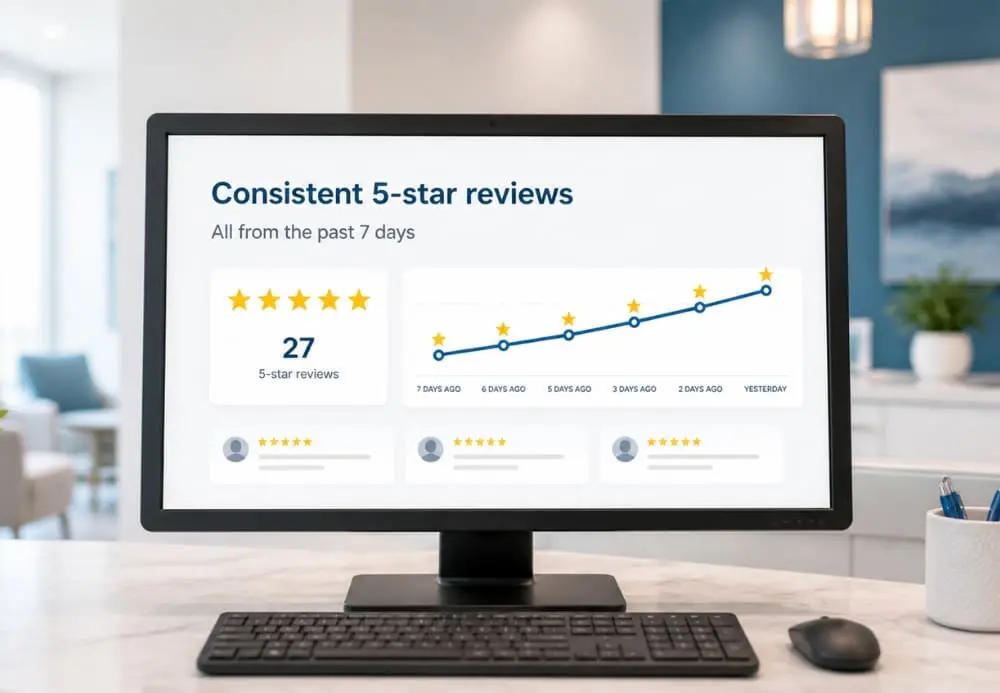
A practice with 400 reviews but none in the past year looks less credible than a practice with 80 reviews and several in the last week. A consistent flow of reviews matters as much as the total count.
Build the habit into your team culture, not just your processes. When the whole team understands why reviews matter and feels comfortable with a natural way to ask, the results compound quickly.